Every person with neuropathy eventually asks the same question. In appointments. In support groups. At 2 AM, when the burning won't let them sleep:
What is actually damaging my nerves?
And for fifty years, the honest answer neurology has been able to give is: we know the damage is there, we can see it on the tests, but we do not know what is causing it.
That is finally beginning to change.
FASCIA: THE TISSUE WRAPPED AROUND EVERY PERIPHERAL NERVE
Peripheral nerves do not travel through empty space.
From the moment they leave the spine to the moment they reach the feet and the hands, every peripheral nerve in the body is wrapped, surrounded, and cushioned by a tissue called fascia.
Fascia is the connective tissue that runs through the entire body as one continuous layer. It sits directly under the skin, filling the space between every muscle, every organ, and every nerve.
If a person could pull the fascia out of a body in one piece, it would come out as a single continuous sheet, running from the scalp to the soles of the feet.
Almost every peripheral nerve in the body runs directly through it — and emerging research over the last several years has established deep fascia as one of the most active, most nerve-dense, and most consequential tissues in the human body, containing six times more pain sensors than the muscle it surrounds.
EVIDENCEPEER-REVIEWED FINDINGS
01 FASCIA AND PERIPHERAL NERVE PAIN
Deep fascia has been shown to contain a high density of nerve endings and to be directly involved in the generation of peripheral neuropathic pain — with pathological changes in the fascia directly exciting the nerves running through it.
Boardman & Schleip, Frontiers in Neurology · 2024
HOW THE TISSUE BUILT TO PROTECT YOUR NERVES STARTS COMPRESSING THEM
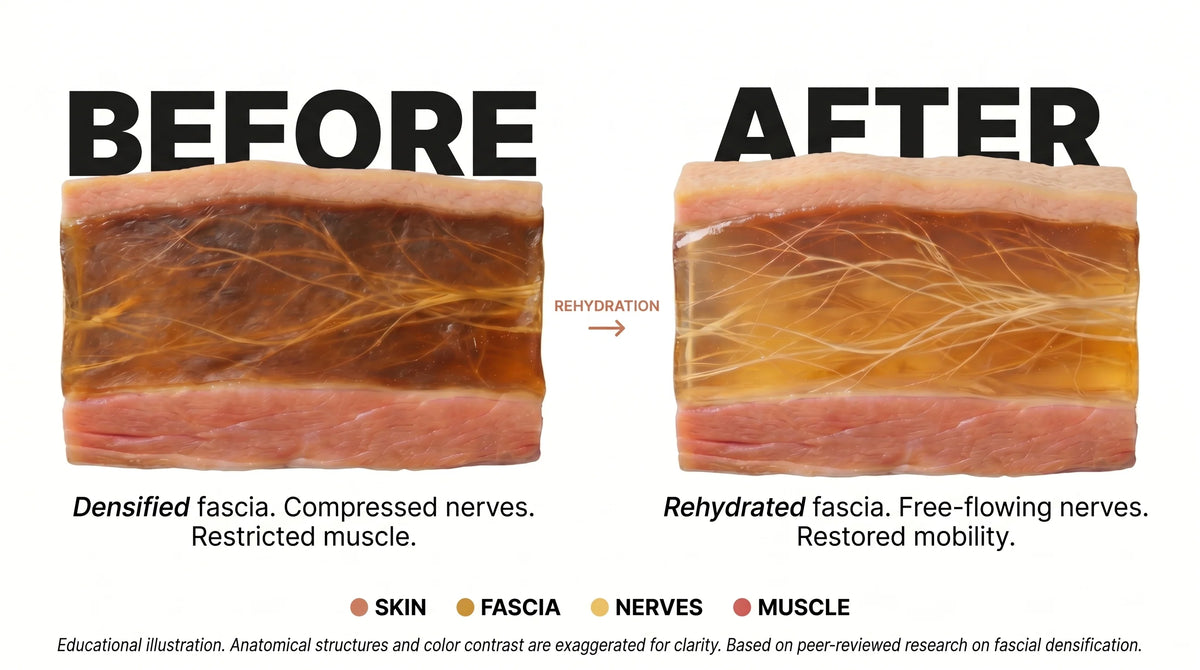
In a healthy body, fascia is soft. Hydrated. Slippery. It cushions the nerves running through it and gives them the space they need to fire normally.
The reason it stays that way is that the body produces a specific set of nutrients — on its own, in the background — that keep the fascia hydrated. As long as those nutrients keep arriving, the fascia stays soft.
In a neuropathy body, that is no longer what it looks like.
Recent studies have documented what happens to the fascia surrounding peripheral nerves in people with neuropathy.
It dries out. It compresses.
The soft, hydrated cushion that used to surround the nerves becomes stiff, rigid, and densified — and it starts compressing the nerves running through it.
Imagine a wetsuit left out in the sun for a year — stiff, shrunken, gripping instead of gliding. That is what has happened to the tissue running through your feet, your legs, and your hands.
And there's a reason it started in your feet.
The nerves that reach your feet are the longest nerves in your body. They start at your spine and travel all the way down — through your hips, your legs, your ankles — running through fascia the entire way.
The longer the road, the more hardened tissue that nerve has to pass through. Which is why the nerves with the longest routes — your feet first, then your hands — are always the first to burn, tingle, and go numb.
When fascia tightens around a nerve, the nerve has nowhere to go. The tissue closes in on it. It gets compressed, pinned in place. And it fires.
That is what neuropathy is.
EVIDENCEPEER-REVIEWED FINDINGS
02 DENSIFICATION AROUND PERIPHERAL NERVES
Recent studies have documented that in patients with chronic nerve pain, the fascia surrounding the affected peripheral nerves shows measurable densification — hardening, thickening, and loss of hydration — physically constricting the nerve trunks running through it and producing chronic pain, tingling, and numbness.
Gromakovskis & Stecco, Frontiers in Physiology · 2025 · Stecco, Stern & Stecco, Current Pain and Headache Reports · 2020
WHY EVERY TEST YOU'VE HAD CAME BACK "NORMAL"
The EMGs, the MRIs, the blood panels — every one of them was designed to measure the nerve. None of them were designed to see the tissue around it.
Your symptoms were real the entire time. They were coming from a tissue no test you've had was built to see.
EVERY SYMPTOM FINALLY MAKES SENSE
Once you understand what densified fascia does to the nerves running through it, the symptoms stop being random. Not several unrelated problems. One problem, showing up in several places.
01
The Burning and Tingling
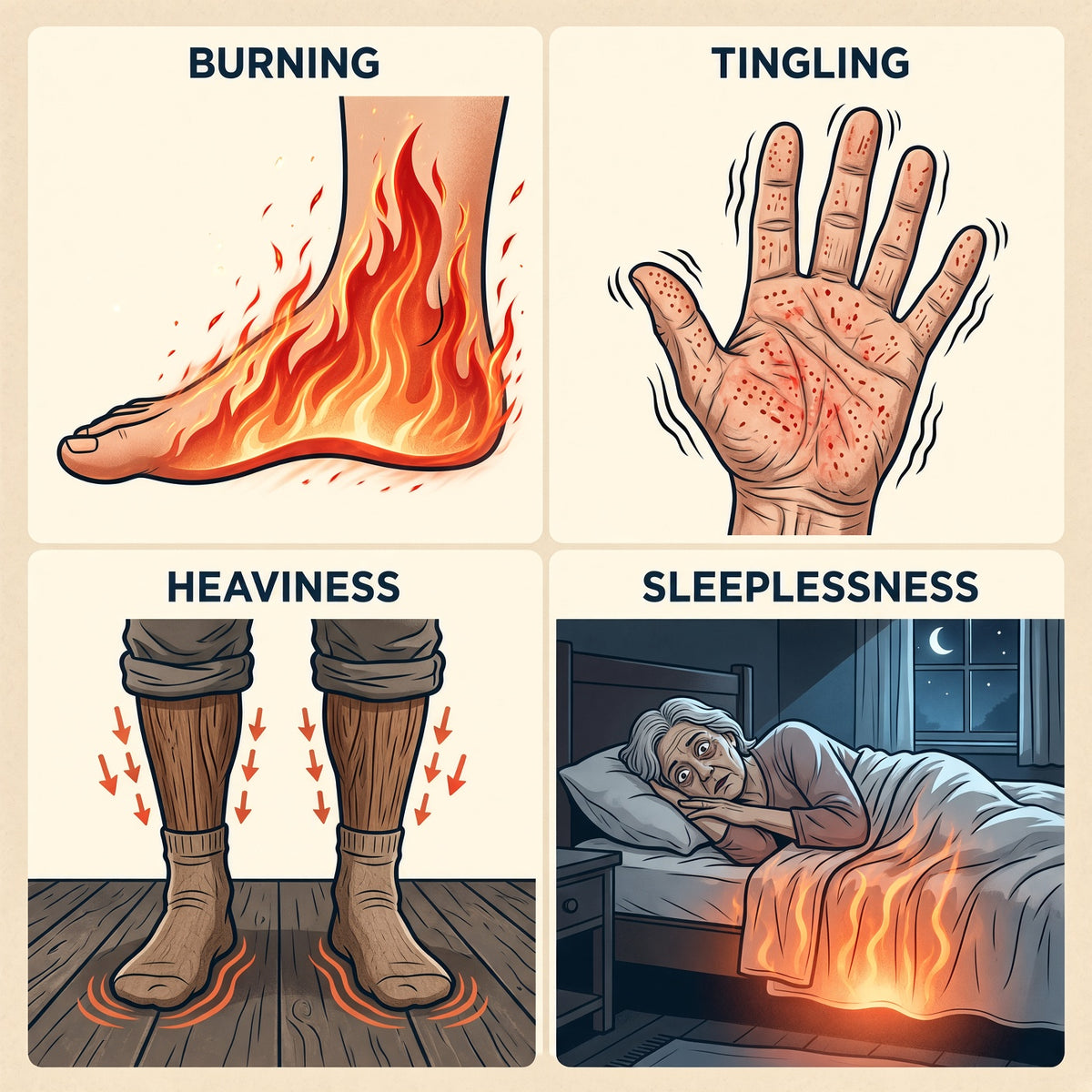
Feet on fire at nightPins and needles that never turn offBuzzing under the skinSheets like sandpaper
Compressed nerves fire pain signals at the volume they are being squeezed at. That is the burning. They also misfire under constant pressure — sending random signals up to the brain that get interpreted as tingling, buzzing, and pins and needles.
Both come from the same source: nerves being pressed on around the clock by tissue that has hardened around them.
02
The Compression
Socks that feel wadded upWalking on pebblesA rubber band around the calfBoots too tight when they aren't
These sensations are not imagined and they are not misfires. They are the direct physical experience of a nerve being squeezed by densified fascia. When a nerve is compressed by tissue, the sensation the brain registers is the sensation of compression — of tightness, of banding, of something wrapped around the limb.
Your body has been reporting exactly what is happening: the tissue around the nerve is squeezing it.
03
The Numbness
Feet that feel woodenCan't feel the floorStanding on someone else's legsBalance quietly going
When the compression tightens far enough, the signal cannot get through the nerve at all. The nerve is still there. The input is being cut off before it reaches the brain. Balance goes with the sensation because the brain is no longer receiving reliable information about where the feet are on the floor.
The numbness isn't the nerve gone. It's the signal being cut off by the tissue squeezing it.
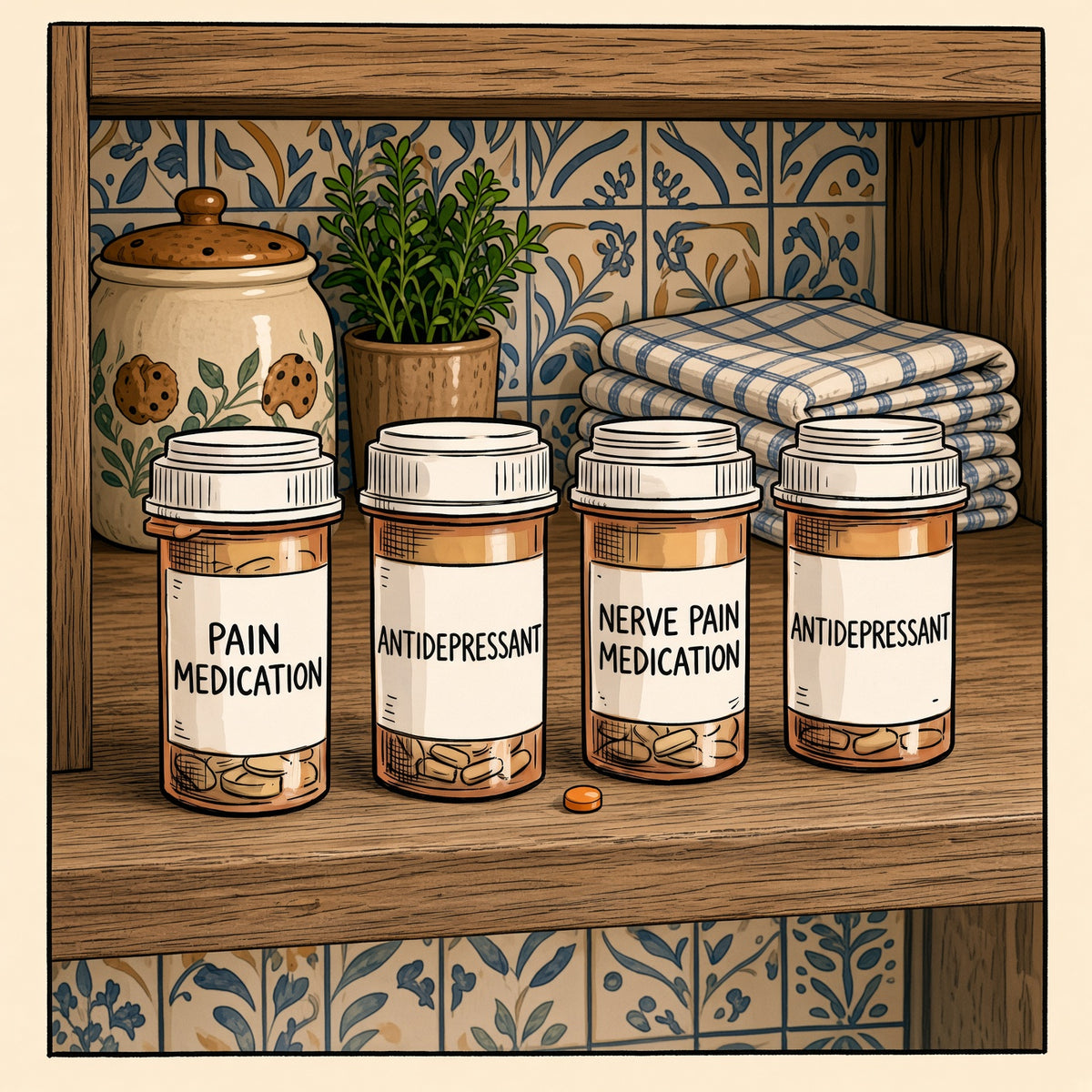
The prescriptions work by turning down the volume on the pain signal your nerves are producing. The fascia is still densified. The nerves inside it are still being compressed. The medication is only changing how loud your brain hears about it.
The nerve vitamins feed the nerve itself — a nerve that is still being compressed from the outside.
None of them touch the fascia.
WHAT FINALLY REACHES THE REAL PROBLEM
Which raised the obvious question.
If the fascia has densified because it stopped receiving the specific nutrients it needs to stay hydrated, then the real answer is not another way to numb the pain it produces — and not another nutrient for the nerve it's squeezing.
The real answer is to give the fascia back what it stopped receiving — so it can rehydrate, soften, and release the nerves it has been compressing.
The problem is that the science of fascia is very new. Almost no serious research existed on this tissue at all until the last five years — and none of it had ever been directed at the question that matters most: what specific nutrients does the body need to rehydrate densified fascia?
That is finally changing. Recent work out of neurology and connective tissue labs has isolated the exact nutrients the body uses to keep fascia hydrated — the same nutrients whose supply drops in every case of neuropathy — and meta-analyses have documented that interventions targeting the fascia measurably improve nerve function and relieve neuropathic symptoms.
EVIDENCEPEER-REVIEWED FINDINGS
03 FASCIAL INTERVENTIONS IMPROVE NERVE FUNCTION
A systematic review and meta-analysis found that interventions targeting the fascia surrounding compressed peripheral nerves significantly improved nerve conduction and produced meaningful reductions in neuropathic pain, tingling, and numbness across multiple neuropathy subtypes.
Albert-Lucena et al., Journal of Clinical Medicine · 2025
THE TURNING POINT CAME IN 2026
Until early 2026, no product on the market was built to do that.
The research was there. The nutrients were identified. The doses were established.
What did not exist was a single formulation that combined them at the levels and ratios required to actually rehydrate the fascia — and no one in the supplement world had built one, because until the fascia research came together, there had been nothing to build one around.
In early 2025, a small group of neurology researchers and fascia specialists decided to take the risk of being first.
They founded a company called Revaliss Labs, and spent the better part of a year on the formulation — sourcing the right form of each nutrient, testing doses, running iterations, working the enzymatic support required to reach the hardened tissue underneath.
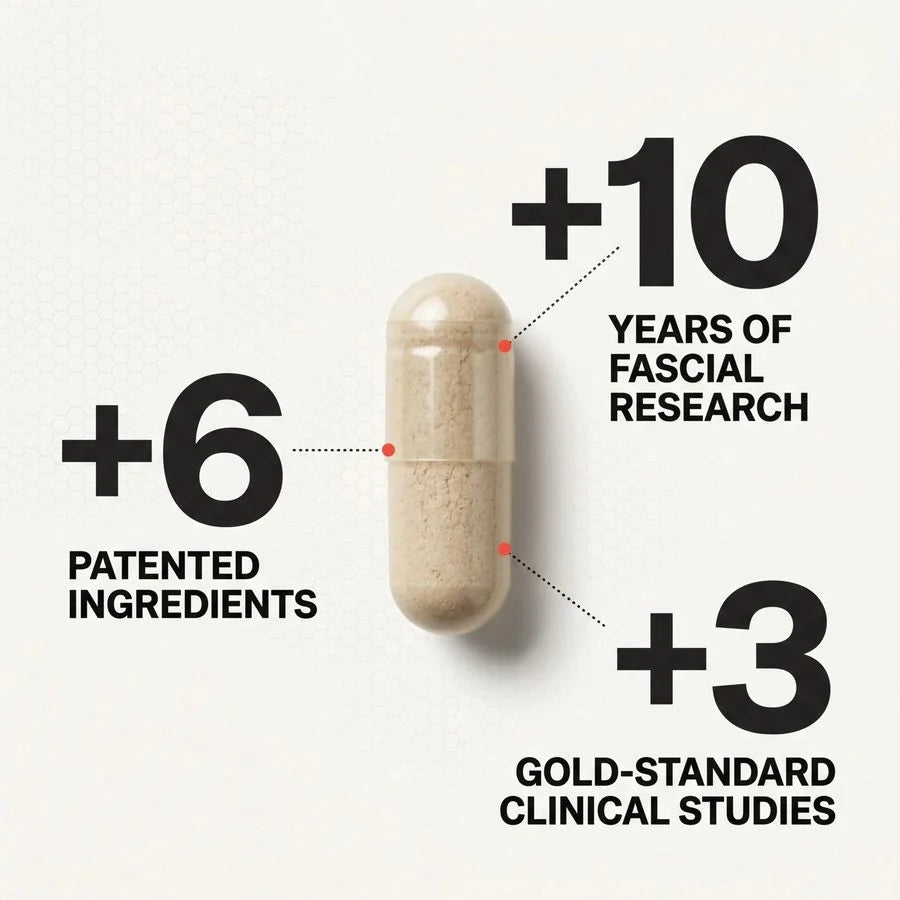
What came out of it is called TrueForm® Revaliss Lab Fascia Release — the first supplement built specifically to rehydrate the densified fascia surrounding peripheral nerves.
TrueForm® was built around the specific nutrients the research has identified as central to fascial rehydration — the same nutrients the body produces on its own when healthy. Each one targets a different part of the mechanism.
Hyaluronic Acid
The molecule fascia uses to hold water. Without it, no amount of hydration reaches the tissue — replenishing it is what allows the fascia to rehydrate from the inside.
Bamboo Silica
bambusa vulgaris
The mineral responsible for fascial elasticity — the property that lets the tissue soften and release its grip on the nerves running through it. Almost entirely stripped from modern food, and one of the reasons densified fascia so rarely rehydrates on its own.
Serrapeptase
A proteolytic enzyme that helps break down the hardened, densified tissue accumulated inside compromised fascia — clearing the buildup that would otherwise block the rest of the formula from reaching the tissue.
Behind those three is a supporting matrix of complementary nutrients — trace minerals, botanicals, and connective tissue precursors — that reinforce the fascia as the main ingredients do their work. As the fascia rehydrates and the densification lifts, the compression on the nerves eases. The burning quiets. The tingling settles. The numbness lifts. Actually refreshing sleep becomes a real thing again.
The version of your body that felt like home starts coming back.
EVIDENCEPEER-REVIEWED FINDINGS
04 ENZYMATIC BREAKDOWN RESTORES NERVE SIGNALING
Enzymatic breakdown of accumulated hyaluronan in densified fascia was shown to restore normal fascial gliding and normalize sensory signaling in the nerves running through it — with measurable reductions in pain and abnormal sensations in patients with chronic nerve compression.
Sikdar, Langevin et al., BMC Musculoskeletal Disorders · 2023
THE REAL-WORLD RESULTS
In early 2026, TrueForm® was released to a first cohort of 1,247 people with a clinical neuropathy diagnosis — all of whom had already failed at least one NHS prescription for the condition — and their symptoms were tracked over a 90–day period.
By day 90, the numbers that came back changed everything.
68%
reported a meaningful reduction in nighttime burning and nerve pain by week four
74%
reported a noticeable reduction in tingling and pins-and-needles by week eight
71%
reported deeper, more restorative sleep by week eight
82%
reported a meaningful reduction in overall neuropathy symptoms by week ten
But the number that stood out most:
74%
of participants reported feeling like themselves again by day 90.
Not marginal. Not incremental. A version of themselves they hadn't felt in years.
Every response came from a real person filling out a form on their phone, in their own words, on their own time.
The researchers behind TrueForm® kept running into the same question — the one every patient asks once they understand the mechanism:
If densified fascia is what's compressing my nerves... what made my fascia densify?
The answer comes back to the nutrients the fascia depends on.
In a healthy body, those nutrients are produced steadily and delivered continuously. The fascia stays hydrated. Nothing about it goes wrong.
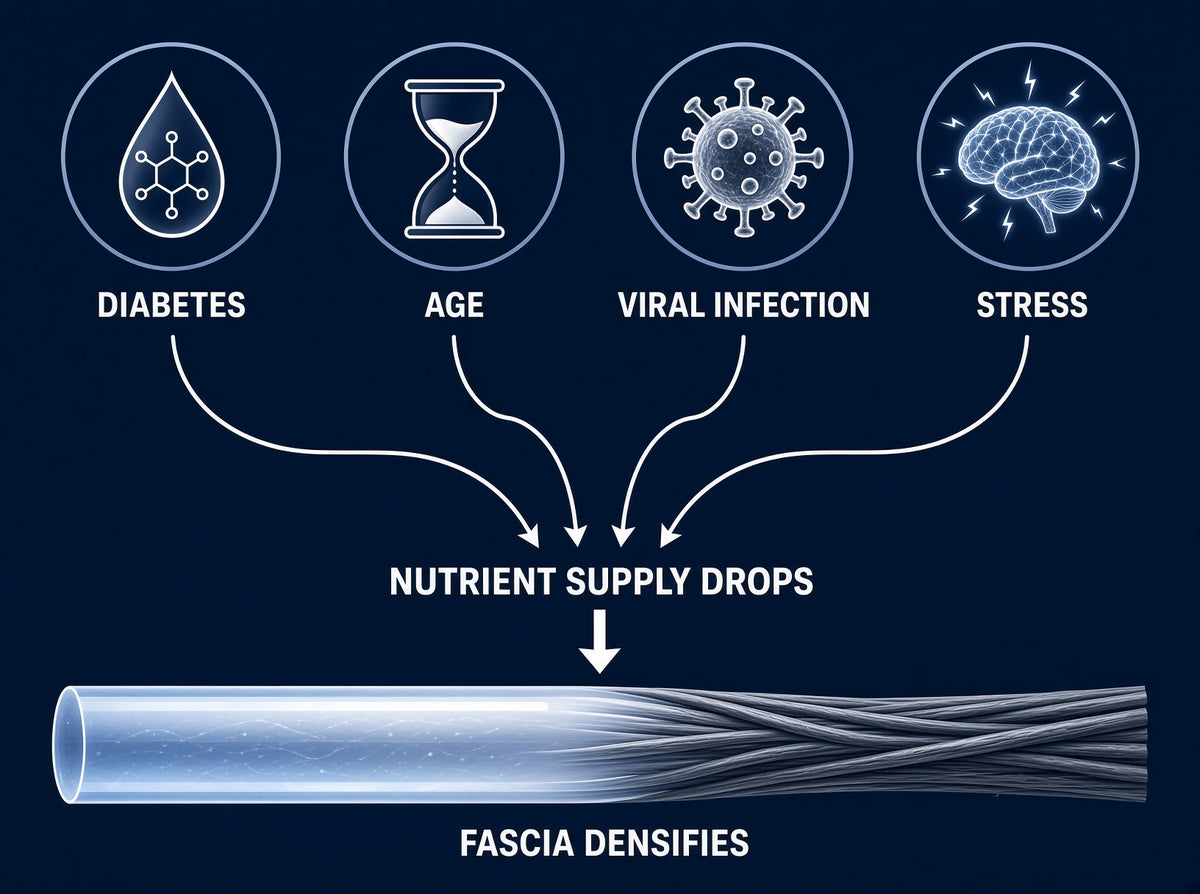
But that supply is fragile. When it drops — for any reason — the fascia loses the hydration it depends on. It begins to dry out. And once it dries out, it densifies along the nerve pathways it surrounds.
What the research is finding is that the trigger for that drop can be a number of different things — but the downstream event is the same in every one of them.
In some people, the trigger is diabetes — years of elevated blood sugar quietly interfering with the body's ability to keep the fascia nourished. In others, it's the aftermath of chemotherapy. In others, a viral infection that never fully cleared, or prolonged stress or trauma rerouting nutrients away from tissues the body doesn't consider critical.
And in many people — most of whom end up with the word "idiopathic" written on their charts — the trigger is something quieter.
As the body ages, its natural production of these fascia–supporting nutrients gradually slows down. For most people, the slowdown is mild enough that the fascia holds up. But for a subset, that decline drops the supply far enough that densification begins and neuropathy follows — with no identifiable trigger, no underlying condition to point to, and no test that can see it.
EVIDENCEPEER-REVIEWED FINDINGS
05 AGE-RELATED DECLINE IN FASCIAL HYDRATION
Research has documented that the body's natural production of the nutrients responsible for keeping fascia hydrated declines significantly with age, resulting in progressively drier, stiffer connective tissue in older adults and helping explain why peripheral neuropathy disproportionately affects people over 55.
Papakonstantinou et al., Dermato-Endocrinology · 2012 · Stern & Maibach, Clinics in Dermatology · 2008
Different starting points. Different histories. Different neurology charts. But whatever the trigger, the fascia stops receiving what it needs — and once it has densified, it does not recover on its own.
It stays densified, it keeps compressing the nerves running through it, and the symptoms keep progressing — until the fascia itself is restored.
Which is exactly the job TrueForm® was built for.
THE PROTOCOL
Two capsules a day. That's it.
One in the morning, one at night. With or without food. No diet to layer on top, no supplement stack to coordinate, no tracking.
No injectionsNo specialistsNo prescriptionNo diet rulesNo timing
Manufactured in an GMP-certified facility in the UK · Third-party tested · Fully vegan · No fillers
THE 90-DAY GUARANTEE
If a formulation reduces the burning, the tingling, and the numbness in the majority of people who had already failed everything else — standing behind it should not be complicated.
Any customer who takes TrueForm® for the full 90 days and does not feel a real difference by the end of it gets a full refund.No shipping the pouches back. No forms to fill out justifying the decision. No conditions.
The window mirrors the 90 days the cohort study covered — the same window in which the majority of participants saw meaningful reductions in symptoms they had lived with for years.
FROM PEOPLE WHO HAD GIVEN UP ON FEELING LIKE THEM SELVES AGAIN
★★★★★
Verified purchases · 4.9 / 5 average rating
Robert K.
★★★★★
Sleeping through the night for the first time in years
06/22/2026
✓ Verified Purchase
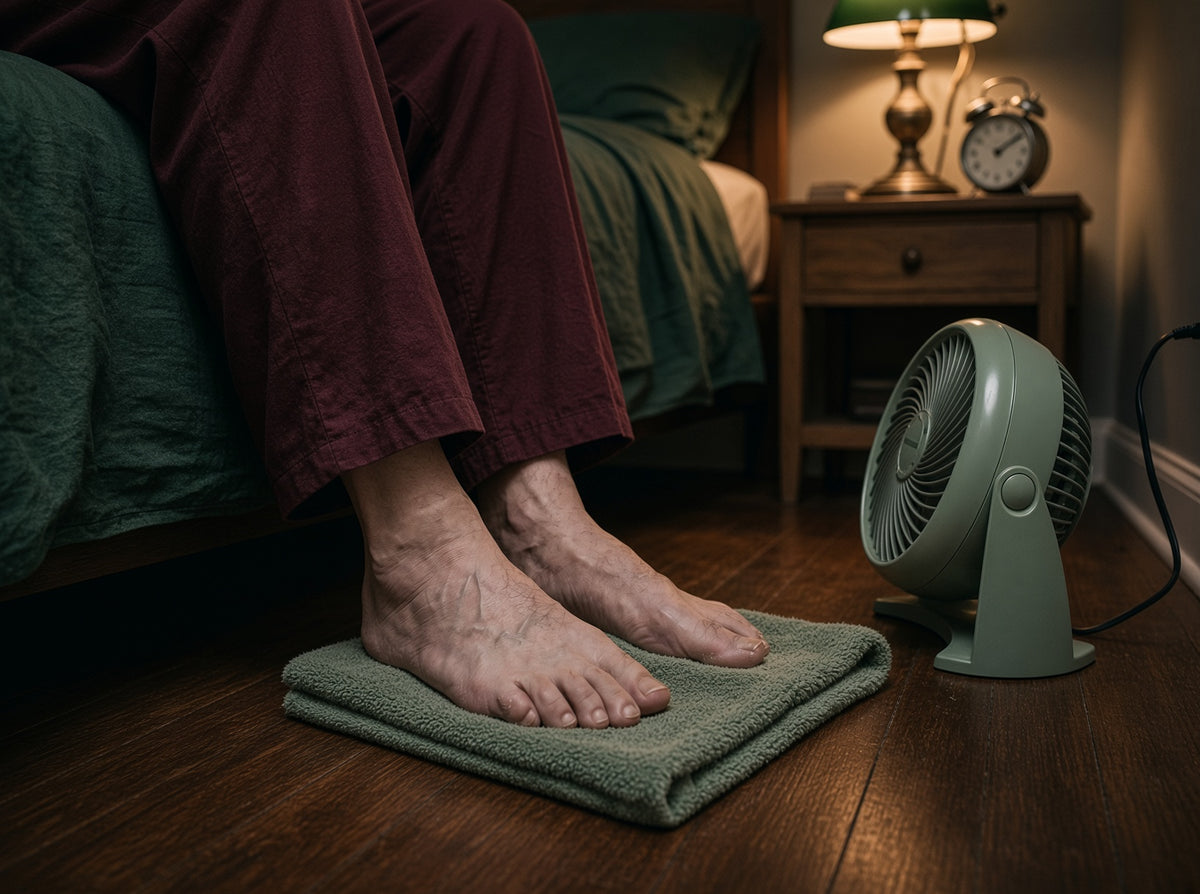
I've had neuropathy for eleven years and the nights have always been the worst part. Feet on fire the second I lay down. Ice packs, fan on in winter, sheets kicked off, sleeping in three–hour chunks if I was lucky.
Started this in March. Around week five the burning started easing at night. Two months in, I slept a full seven hours for the first time I can remember. My wife noticed before I did. That alone has been worth every penny.
Margaret D.
★★★★★
I can feel the floor again
06/17/2026
✓ Verified Purchase
I'm 68 and I'd honestly made peace with the fact that my feet were going to keep going numb until I couldn't walk anymore. My neurologist told me the damage was permanent. I let this sit in a drawer for two weeks before I even started it — I didn't want to get my hopes up again.
I'm glad I finally did. Three months in and I can feel my feet on the kitchen floor when I get up in the morning. Small thing to most people. It's everything to me.
Diane R.
★★★★★
The tingling is finally quieting down
06/13/2026
✓ Verified Purchase
Had constant pins and needles in both feet for six years. Gabapentin took the edge off but left me feeling like a zombie all day.
Started this in April. About six weeks in the tingling started actually quieting down instead of just being masked. I'm sleeping better, I'm walking better, and I've been able to cut my gabapentin in half. First thing that's actually done something at the tissue level instead of just numbing me out.
LIMITED SUPPLY
Practitioner allocation first
TrueForm® is not always in stock.
It is manufactured in small clinical batches in an GMP-certified facility in the UK. A portion of every batch is reserved for the 500+ neurologists, pain specialists and rehab consultants distributing it within their practices. Whatever remains is released to the public, first–come, first–served.
When a batch sells out, the next one takes six to eight weeks to produce, and customers already on the protocol are placed ahead of new customers for restocks.
But if TrueForm® is in stock, this is an invitation to join the thousands of people who are already on it.